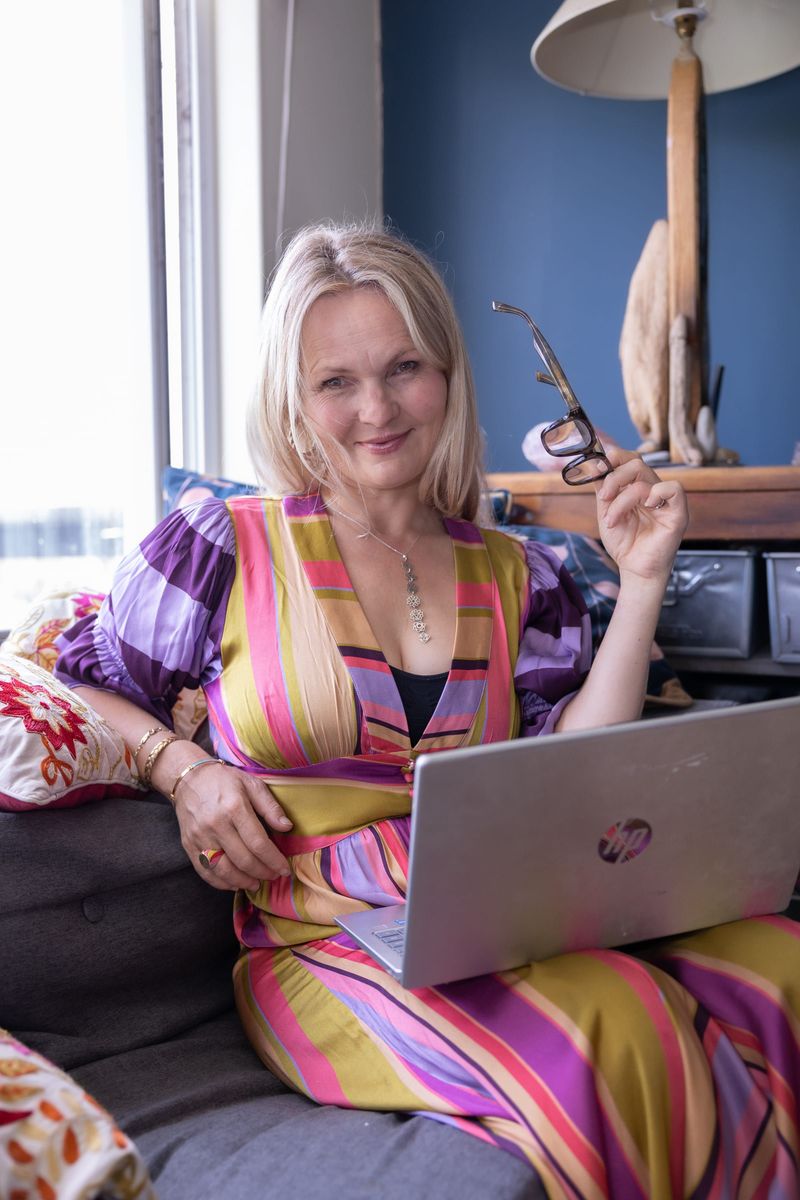
I'll be honest about what stopped me from starting a YouTube channel for years. It wasn't the technical challenge. It wasn't the time. It was the thought of my face, speaking directly, to an unknown number of people about things that actually matter to me.
People hear that and assume it is shyness. It is not. I have stood in front of rooms. I have sold things to strangers for 22 years.
The difference is the direction. In a room you can see what is landing and adjust while you go. On camera you are talking into nothing, and you find out later, from people you cannot see, in writing.
The things I talk about in my videos require real honesty. And real honesty, at scale, is terrifying.
And the fear is a specific one, which took me a while to work out. It is not being disliked. It is being disliked for the true version rather than the manageable one. Being disliked for the manageable version costs you nothing at all, because it was never you.
That is the trade, and it is the same trade whatever the camera is pointed at. The safer version is easier to publish and no use to anybody.
What changed was working with enough women to understand that the honest version, the one where I actually say the thing rather than a safer adjacent version, is also the useful one. The video where I'm slightly uncertain, reaching for the right word, that is the one that lands. Because the woman watching is also slightly uncertain, reaching for the right word.
That is worth being practical about, because it is not a licence to be vague.
The uncertainty that works is uncertainty about the words, not about the thing. Anybody watching can tell the difference between somebody choosing a word carefully and somebody who has not thought about it. A polished sentence written to sound right is smooth, and smooth slides off. A sentence being found while you watch it being found does not.
What that means in practice is fewer scripts, more notes, and a willingness to leave the pause in.
Here is how the not doing it looks in an ordinary week, because it is almost never a decision not to.
You have the idea in the morning and you know exactly what you want to say. By lunchtime you have decided today is not the day, the light is wrong, you will do it properly at the weekend. At the weekend you watch 10 minutes of somebody else doing it better and the idea has gone quiet.
Nobody ever decides not to. They keep deciding not today, and not today is made of a hundred small reasonable things.
There is a physical part to it as well, and nobody mentions it. The first few times, your voice sits higher than it does in a kitchen and your breath runs out halfway through a sentence, because a part of you has decided that a lens is a room full of people. That settles on its own after a while. It is not a sign that you are bad at this. It is a body doing exactly what it is built to do.
What people try first is getting ready. A better camera, better light, a plan for the first 12 videos, a look at what is working for other people.
None of which is wrong, it just cannot be done first. Getting ready is a way of being in the room with the thing without doing the thing, and it feels exactly like progress, which is the problem.
The second thing people try is making it less personal. Tips. Lists. Something safely useful. That is genuinely easier to publish, and it is also the version nobody writes back about.
The third thing is waiting to feel ready, which is the most reasonable of the 3 and the one that lasts longest, because the feeling does not arrive in advance. It arrives afterwards, and only sometimes.
What actually moves it is lowering the stakes of each individual video rather than raising the quality of the first one. One video is not a verdict. Fifty videos is a verdict, and nobody gets to fifty while every one of them is an event.
So the rule that works is one take, in whatever room you are already in, on one thing you would happily say out loud to a friend who asked. If it needs a second take for the words, take it. If it needs a second take to be more impressive, publish the first.
It also helps to be clear about who you are talking to. Not an audience, which is a crowd and impossible to speak to honestly. One person, who you can picture, who asked you a real question. Everything about the way you say it changes once there is only one of her.
The other half of it is deciding in advance what you are not going to talk about. That sounds like the opposite of honesty and it is what makes honesty possible. A line you have drawn deliberately is a line you can speak freely inside. Without one you end up hedging everything, because any sentence might be the one that goes too far.
The Reset with Anna lives at 4 playlists. Reset Talks, honest conversations about nervous systems and what it means to come through things. Come Back to Yourself, the practical practices. Jewellery with Meaning, the pieces and the stories behind them. Houseboat Life, the real-life layer.
Four playlists is also the answer to what to make, if you are stuck. Not 4 ideas. Four kinds of thing, so that on a flat week there is still somewhere to go.
And what to watch, if you start, is not the view count. It is the replies. The view count tells you how many people arrived. The replies tell you whether you said the true thing or the adjacent one, and that is the only number worth anything.
New video every week.
More like this.
Visibility anxiety, why you're not showing up and what to do about it. https://www.annalouwellness.com/work-and-money/visibility-anxiety-why-you-re-not-showing-up-and-what-to-do-about-it
Why I do this work https://www.annalouwellness.com/love-and-relationships/why-i-do-this-work-nervous-system-regulation-and-somatic-release
Why the talks that terrify me are the ones worth giving. https://www.annalouwellness.com/reset-stories/why-the-talks-that-terrify-me-are-the-ones-worth-giving
The letters are the written version of the same thing. One a week, nothing to do. resetletters.substack.com.