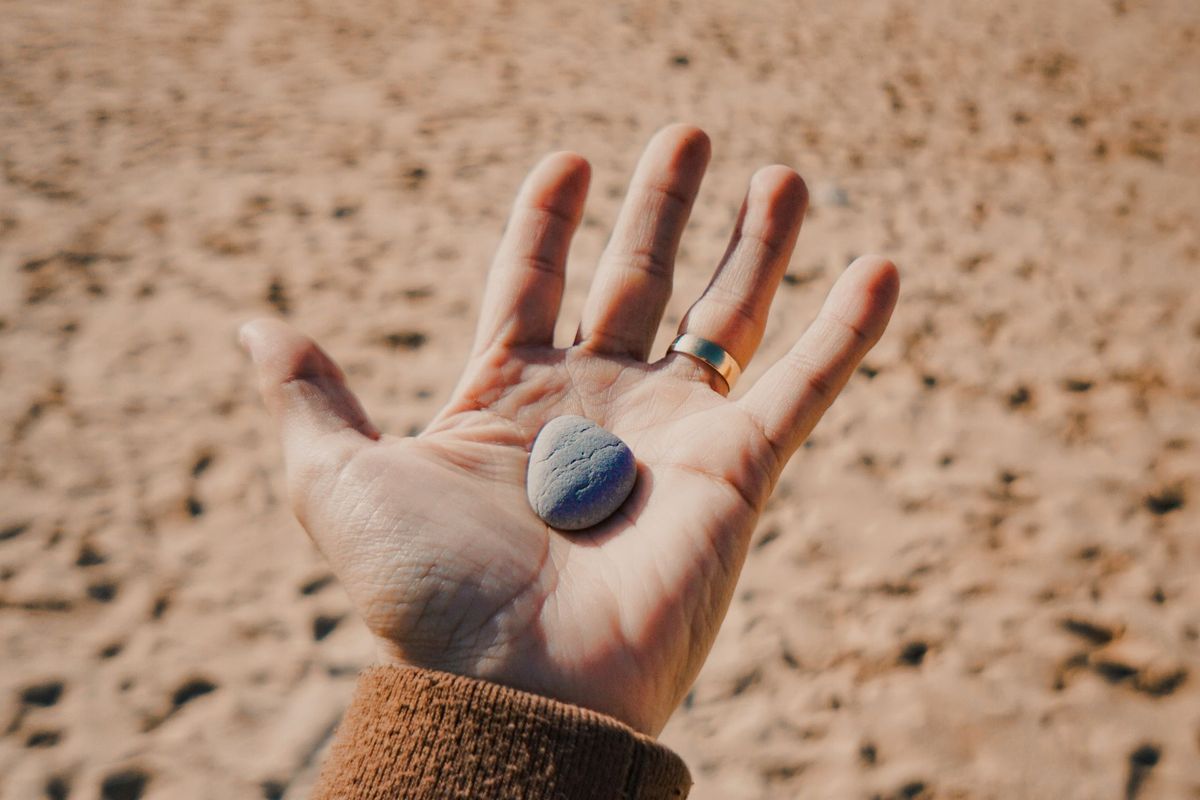
You don't need a collection. You need 1 stone. The right one for right now.
Here's how I tell people to choose: don't research it first. Go to where the crystals are and pick up the one you're drawn to. Or choose from an image online based on which one you keep returning to. That pull is already your intuition working.
I know how that sounds next to a list of properties, so let me say why I put it in that order.
If you read the list first, you choose with the part of you that solves problems. You pick the stone for the thing you have decided is wrong with you, which is usually the thing you are most impatient about.
Choose by the pull and you tend to end up somewhere more honest. People reach for the gentle one when they have been hard on themselves for months and would never have put that on a list.
For beginners, the 5 I recommend most, with what each is traditionally associated with: Clear Quartz (clarity and intention), Rose Quartz (self-love and gentleness, for women being hard on themselves), Amethyst (calm and settling), Black Tourmaline or Onyx (protection and grounding, good for anyone who absorbs other people's energy), and Moonstone (intuition, cycles, inner knowing).
Those are traditional associations, which is a careful phrase and I mean it carefully. It is what these stones have been used for, across a long time and a lot of places. It is not a claim about what will happen to you.
On not spending a fortune, because it is in the title and it matters.
A small tumbled stone costs very little. A large polished specimen costs a great deal more and does nothing additional. Size is about display.
Buy 1. Live with it for a month. If you find you never pick it up, you have learned something cheaply, and if you find it is always in your pocket by Wednesday you will know what to get next.
The expensive mistake is the set. A box of 12 arrives, you cannot remember which is which, and the whole thing becomes an ornament. A practice with 1 object in it is a practice. A drawer of them is a cupboard.
Once you have your stone, the practice is simple: hold it consciously. 5 minutes in the morning. During a difficult call. The stone isn't doing anything complicated. It's giving your nervous system a physical anchor for the intention you've already set.
Conscious is the operative word, so here is what it actually looks like.
You pick it up. You feel the weight and the temperature, which will be cooler than your hand and then will not be. You say to yourself, in whatever words you use, what you want this part of the day to be like. Then you put it down and go and do the day.
That is 40 seconds. It does not need to be 5 minutes unless you want it to be.
The reason it works is not mysterious. An intention that stays in your head is weather. An intention attached to an object you will touch again at 3pm is a reminder that exists outside your own mood.
Keep it where your hand already goes. A pocket, the side of the sink, next to the kettle, the car. A stone on a high shelf is decor.
What it does not do, and I would rather say this than have you find out and decide the whole thing is nonsense.
It does not sort out the situation. It will not change the person who is being difficult or make the decision for you. Nothing you hold in your hand does that.
It will not work as a substitute for the actual thing you are avoiding. If a conversation needs having, no stone takes its place, and using one to feel like you have acted is the main way this becomes a way of not acting.
And it does not have to be the stone at all. If crystals are not your language, the same mechanism runs on anything deliberate. A ring you turn. A smooth pebble from the beach you went to. The point is the chosen object and the pause.
What people tend to notice first is the pause itself rather than anything about the stone. A few seconds between the day arriving and you answering it.
Then, after a few weeks, that they have reached for it without deciding to, usually in the middle of something. That is the bit I like. Your hand knew before you did.
On where to buy, because not spending a fortune is partly about not being sold to.
A decent seller will tell you what a stone actually is and roughly where it came from. If nobody can answer that, you are buying a colour.
Dyed stones are common and not a scandal, but they should be described as dyed. A price that looks too good for the size usually means glass or resin, and a stone that is suspiciously uniform often is.
None of that matters enormously for a first stone. It starts to matter once you are choosing a second one and have begun to care.
And if you already own one that somebody gave you, start with that. An object with a person attached to it is doing more than anything you could buy this week.
The Crystal Starter Kit is where I'd start. Everything to begin with. Nothing unnecessary.
More like this
The crystal guide, which stone is right for you and when. https://www.annalouwellness.com/love-and-relationships/the-crystal-guide-which-stone-is-right-for-you-and-when
How to start working with crystals, without it feeling strange. https://www.annalouwellness.com/love-and-relationships/how-to-start-working-with-crystals-without-it-feeling-strange
Energy clearing for the sceptics, 3 things that work even if you don't believe they will. https://www.annalouwellness.com/love-and-relationships/energy-clearing-for-the-sceptics-three-things-that-work-even-if-you-don-t-believ
The stones I keep are in the shop, at https://www.annalouwellness.com/shop?category=crystals, if you want a look at what is there.